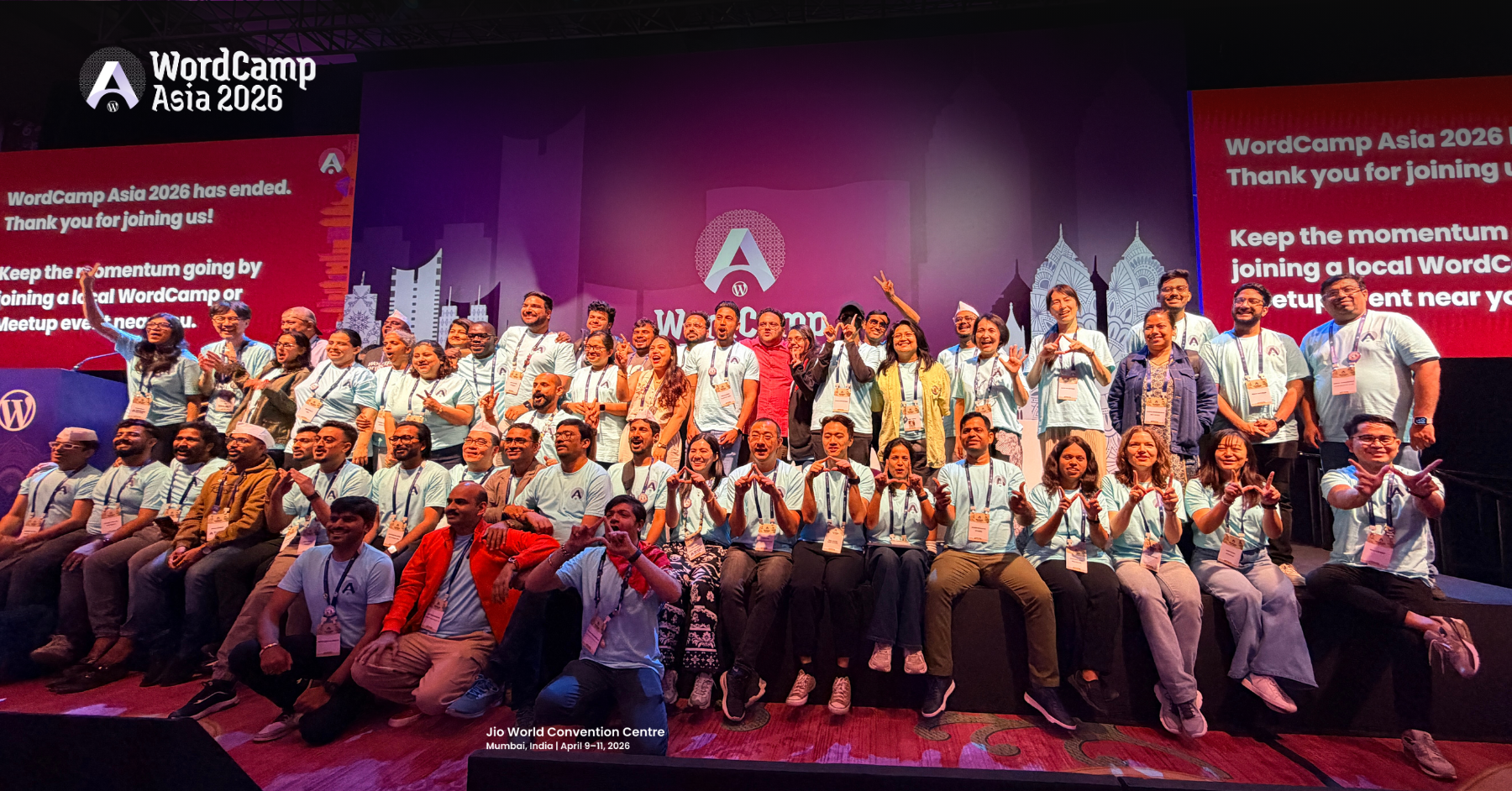
Day 2 of WordCamp Asia 2026 arrived with a different kind of energy. Not the wide-eyed curiosity of a first day, but something sharper — a community that had already found its footing, reconnected with familiar faces, and was ready to go deeper. Around 80 new attendees joined the fold, adding fresh momentum to an already charged atmosphere, and from the moment the doors opened at 8:00 AM, it was clear that this was going to be a full, eventful, and memorable day.
The WordPress Support station, a consistent presence throughout the entire event, stayed busy and engaging from start to finish. For many attendees, it remained a natural first stop — a place where questions were met with patience and genuine enthusiasm, and where the community’s commitment to helping one another was most visible.
Into the Morning: Sessions Across All Three Tracks
The day got underway swiftly. By 9:15 AM, sessions were already in full flow across the Foundation, Growth, and Enterprise tracks, each room finding its rhythm and its audience.
One of the early standouts was Fellyph Cintra’s session, WordPress Playground + AI: Building Autonomous Testing Pipelines, which set the tone for the AI thread that would run through much of the day. Fellyph explored how WordPress Playground, combined with AI-driven workflows, can fundamentally transform how developers approach testing — moving from manual, reactive processes to autonomous pipelines that catch issues faster and at greater scale. For developers in the room, this was one of those sessions where a tool they already knew suddenly felt far more powerful.
Across the other tracks, the morning block covered a wide range of themes. Sessions on product strategy, developer workflows, and the business of running WordPress-powered companies gave attendees from very different backgrounds something immediately relevant to take back. The sponsor hall, meanwhile, was already buzzing, a pattern that would continue throughout the day, with most of the footfall gravitating there as the morning progressed.
Breakout Sessions and Workshops

From 11:15 AM, the schedule shifted into breakout sessions. Attendance in the breakout rooms felt a bit lower, as most attendees had gathered in the sponsor hall where conversations, demos, and informal exchanges had taken on a life of their own. But the sessions that did run were focused and substantive.
Adeline Dahal’s session, Entity-First Optimization: How to Make WordPress Content Machine-Readable, was one of the most practically relevant of the day. As AI-powered search and content discovery reshape how audiences find information, the session addressed a challenge many WordPress site owners are only beginning to grapple with — how to structure content so that it works not just for human readers but also for the systems that increasingly mediate between content and audience. It was a timely, forward-looking talk with clear and actionable takeaways.
Shortly after, JC Palmes brought a different kind of practicality to the room with From Chaos to Clarity: Scaling Teams with Block Theme Standards. This was a session built for teams that have outgrown improvised workflows — a structured, honest look at how block theme standards can bring consistency, reduce friction, and help growing teams move faster without losing quality.
The workshop rooms, running parallel throughout the day, told a different story from the breakout sessions. Participation remained consistent and interactive, with attendees coming in ready to engage, ask real questions, and work through practical challenges alongside facilitators. These were not passive learning spaces; they were rooms where things got built and where the learning was visible.
Enterprise Perspectives: Building for Scale and What Comes Next


The post-lunch block brought some of the day’s most forward-looking conversations. James Giroux’s session, Build for What Comes Next: How Enterprise WordPress Is Powering the Agentic Future, arrived at an important moment in the day’s narrative — just as attention was sharpening and the afternoon energy was building. The session reframed what it means to work with WordPress at scale: rather than focusing on execution-based services, the emphasis is on evolving into strategic partners who bring intelligence and long-term thinking to the table.
Also in the Enterprise track, Abid Murshed’s session on Cross-Border Commerce from India: What’s New, What’s Next, and How to Build a Business That Scales resonated strongly with the entrepreneurial segment of the audience. Abid, Market Leader for PayPal India, explored how Indian businesses can tap into global markets, with a sharp focus on the complexities that come with doing so — cross-border payment regulations, tax structures, and the operational challenges that are easy to underestimate.
Malay Ladu’s session, Art of Integration: Making WordPress Work for Everything, made a compelling case for something that often goes underappreciated — the real power of WordPress is not just in what it does out of the box, but in what it becomes when connected to the broader digital ecosystem.
The Panel Discussion
One of the more considered moments of the day came during the panel discussion. While audience turnout was relatively modest compared to other sessions, those who were in the room were genuinely engaged. The conversation was thoughtful and wide-ranging, touching on open source sustainability, community leadership, and the evolving responsibilities of those who build and maintain the web’s most widely used platform. It was the kind of session that rewards attention, and for those who stayed, it delivered.
The Speed Build Challenge: A Thrilling Tie


If there was one session that drew the largest crowd of the day, it was the WordPress Speed Build Challenge, facilitated by Ajay Maurya, Craig Gomes, and Jamie Marsland. The format was as simple as it was high-stakes: build a complete WordPress website in 30 minutes, live on stage, using only the Full Site Editor — no page builders, no custom code.
What made the challenge stand out was that it went beyond speed. It was a demonstration of what WordPress core is genuinely capable of when used with fluency. Efficient workflows, smart use of blocks and patterns, decisive design choices, all of it on display in real time. When the results came in, it ended in a tie — an outcome that somehow felt more satisfying than any single winner could have. Two builders, equal skill, equal determination. The crowd’s reaction said everything.
The Closing Keynote: A Q&A with the Panelists


The closing keynote slot was the most anticipated moment of the three-day event, scheduled to feature Ma.tt Mullenweg, co-founder of WordPress. Due to a health issue, Ma.tt was unable to attend the closing ceremony. The warmth and concern from the community were immediate and genuine.
What followed, though, was anything but a letdown. The Q&A session — led by panelists Mary Hubbard, Chenda Ngak, Peter Wilson, and Sergey Biryukov — stepped into that space with real depth and conviction. The conversation was engaging, candid, and covered topics the community clearly cared deeply about: the future of WordPress, the open-source philosophy that continues to drive the project forward, and how the platform is evolving in the age of AI and digital transformation.
A special and deeply meaningful moment came when Mary Hubbard formally announced WordCamp India — a significant milestone for the Indian WordPress community, and a recognition of the scale, energy, and warmth that Mumbai had brought to this event. The room responded with the kind of applause that only comes from a crowd that genuinely feels seen. The keynote closed on a strong, community-driven note, leaving the room feeling not just proud of what WordPress is, but genuinely excited about what it is becoming.
Sponsor Raffle Ceremony
The sponsor raffle ceremony brought the hall together in a way that few moments can. It was fun, lively, and full of the kind of spontaneous energy that makes in-person events irreplaceable. Winners were announced to cheers, and the crowd that had been spread across rooms and corridors all day found a common and joyful reason to be in the same place at the same time.
Closing Remarks and a Historic Announcement

The global leads took to the stage for the closing remarks, and the words that followed were inspiring in the truest sense; sincere, grounded, and reflective of the real work that had unfolded over three days in Mumbai.
Two announcements brought the house down. India was officially named the fourth flagship WordCamp host country, a proud recognition of everything the community here has built and continues to build. And then, to enormous excitement, Penang, Malaysia was announced as the host city for WordCamp Asia 2027, scheduled for April 9–11, 2027. For a community that travels, contributes, and connects across borders, this was exactly the kind of news that turns a closing ceremony into a beginning.
A Fitting End to WordCamp Asia 2026

Three days. One city. One extraordinary community.
WordCamp Asia 2026 came to Mumbai and left something behind that will last well beyond the event itself. From the first contributions of Contributor Day to the final session of Conference Day 2, what was built here, the ideas exchanged, the sessions delivered, and the connections made are exactly what keep WordPress moving forward.
To every attendee, speaker, sponsor, volunteer, and organiser who made Day 2 what it was: thank you. The web is open because people like you choose to keep it that way.
See you in Penang. 🇲🇾
Warm Regards
WordCamp Asia 2026 Organizing Team
